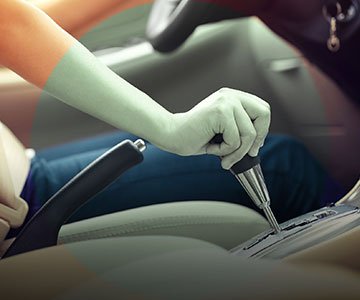
Before you book a first lesson, there is one decision that shapes everything after it: automatic or manual. It affects how quickly you settle in, what your licence lets you drive, and which cars you can buy later. We teach in automatics only, so we have a view, but this guide sets out both sides so you can decide for yourself.
The key difference: what your licence covers
Pass your test in a manual car and you can drive both manual and automatic cars. Pass in an automatic and your licence covers automatic cars only. If you want to drive a manual later, you must take another practical test in a manual car.
That is the strongest argument for manual. It matters if you expect to drive a manual work van, share a manual family car, or hire cars abroad, where manuals are still common.
Why more learners are choosing automatic
The balance is shifting quickly. Analysis of DVSA figures by AA Driving School found that almost three in ten car driving tests in 2025/26 were taken in an automatic, up from roughly one in twenty-five in 2007/08.
The main reason is the cars themselves. Every fully electric car is an automatic, and so are most hybrids. Learners can see that the cars they are likely to buy over the next ten years will not have a clutch pedal.
What learning in each feels like
Automatic
- No clutch and no gear changes, so there is less to coordinate
- No stalling at junctions and no rolling back on hill starts
- More attention left for mirrors, road position and hazards
- Often a calmer start for nervous learners
Manual
- More to learn in the first few lessons: clutch control, biting point and gear selection
- Stalling is part of the process, and it passes with practice
- A fuller sense of control that some drivers enjoy
- A licence that covers every car
Is the automatic test easier?
The test is the same whichever car you take it in: the same kinds of road, the same manoeuvres and the same marking. You might expect automatic pass rates to be higher, but DVSA figures have consistently shown the opposite. The automatic pass rate reached 44.6% in 2025/26, its highest on record, yet it has historically sat a few points below the manual rate.
The lesson from that is simple. Most people do not fail on gears. They fail on observation at junctions, mirror checks, road positioning and responding to signs and signals. An automatic frees up attention for those things, but it does not replace the hours of practice needed to get them right.
What about cost?
Automatic lessons often cost a little more per hour than manual ones, and automatic cars can cost more to buy and insure. Against that, you do not spend your early lessons on clutch control. What matters is the total you spend to reach test standard, not the hourly rate. Our own prices are on our driving lesson prices page.
Who should choose which?
Choose automatic if:
- You want the most direct route to driving confidently
- You are a nervous learner, or have struggled with a clutch before
- You expect to drive an electric or hybrid car
- You will mostly drive in city traffic, where constant gear changes are tiring
Choose manual if:
- You know you will need to drive manual vehicles for work or family
- You want the widest choice of inexpensive first cars
- You are happy to spend extra time mastering the gearbox
Our view
For most new drivers in Edinburgh, with its hills, roundabouts and stop-start traffic, an automatic makes the early stages calmer and keeps the focus on safe driving. That is why we teach in automatics only. If that sounds right for you, read more about learning to drive in an automatic or get in touch to book a first lesson.
Related reading: How many driving lessons do you need?